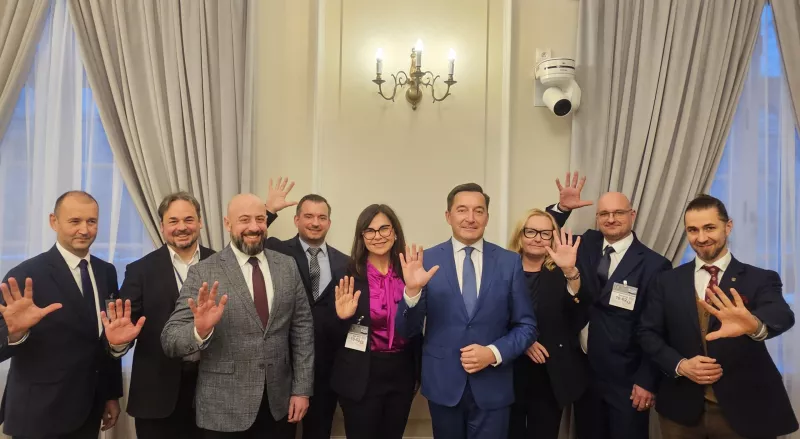
On 10 February 2026, the Sejm Infrastructure Committee devoted a special session to the “Five Points for Rail Freight” project, a joint initiative of key sector organisations. The signatories were represented by the leaders and experts of all the organisations behind this joint undertaking, namely the Land Transport Chamber of Commerce (IGTL), Railway Business Forum, the ProKolej Foundation, the “Private Wagons” Association (SWP) and the Association of Independent Rail Carriers (ZNPK). The session was attended by representatives of the Ministry of Infrastructure, headed by Undersecretary of State responsible for rail, Piotr Malepszak.
At the session we presented our proposal and its key elements, which include:
- Developing point rail infrastructure, i.e. intermodal terminals, loading points and sidings, through systemic State support;
- Reducing the costs of access to infrastructure and traction energy;
- Supporting technological progress in the renewal of rolling stock and the expansion of fleets, and in improving operations, including the digitalisation and automation of logistics processes;
- Establishing and implementing rail corridors for heavy transport;
- Investment and maintenance work aimed at the productivity of freight services.
The development of rail freight is one of the most important investments in Poland's future. It is rail that makes it possible to build an efficient, competitive economy and stable supply chains. In the context of dynamic geopolitical change and the ongoing war beyond our eastern border, the role of rail is growing further – it is becoming a pillar of military logistics and the supply system, strengthening the country's military and strategic security, and it is also crucial for serving large infrastructure projects that require constant deliveries of raw materials. Shifting a larger share of freight onto rail also brings concrete, tangible benefits for people and the environment: fewer lorries on the roads mean fewer accidents, lower noise and lower emissions, as well as real relief for urban areas and the main transport corridors.
At the outset, the Ministry of Infrastructure gave a presentation summarising the current situation in rail freight. The data clearly show that this market segment has long been stagnating and has recently shown a downward trend. Despite improved operating parameters on the network and some momentum in intermodal transport, rail is not increasing its share of overall freight and is not benefiting from the growth in volumes resulting from economic growth.
In his opening remarks, Minister Malepszak drew particular attention to the need to level the playing field between rail and road transport by tightening and extending the system of charges for access to road infrastructure. He highlighted the recent increase in the average commercial speed of freight trains and, above all, the infrastructure manager's focus on harmonising the parameters of rail lines over long sections, for example as regards permissible axle loads. He also mentioned the need to stabilise the investment process, which will be achieved through the reform of the Railway Fund that the industry has successfully campaigned for. He concluded by noting that there is much work that the railway community itself must do on the efficiency of operations, on the part of both carriers and the infrastructure manager.
Later in the session the signatories of the initiative took the floor. The President of IGTL, Marita Szustak, stressed that this second “Five Points” (after the “Five Points for Polish Construction”) is again a set of shared proposals from an entire sector – here, rail freight – developed and presented by the most important industry organisations. Once again the market is able to speak with one voice about the need for real action in response to systemic challenges, because years of stagnation in rail freight are a waste of potential and an economic loss. The industry does not merely complain, continued President Szustak, but proposes concrete solutions. Even if these are not simple or quick measures, we cannot avoid a substantive debate.
The issue of point infrastructure and sidings was raised by the Chairman of the RBF Board, Adrian Furgalski, who pointed out that cargo has to be loaded and unloaded somewhere. It seems obvious, but we have a problem with it. There are too few transshipment terminals and too few incentives to connect sidings to the rail network, so new factories and large warehouses advertise their access to roads and forget about rail. We have an idea of how to change this, both legally and through financial incentives.
Jakub Majewski, President of the Management Board of the ProKolej Foundation, noted that rail is currently losing out to road transport also because of energy prices. The cost of electricity for locomotives has been rising steadily for several years, and tariffs and taxes bear no relation to the realities of the industry. One example is the provisions on the capacity charge and the renewable energy (OZE) levy, which in their current form discriminate against rail, even though it should be treated as an energy-intensive sector and, above all, a low-emission one. The development of rail freight, he added, is an instrument that reduces the pressure to build ever more roads and lanes, which fill up with lorries almost instantly – meaning fewer accidents, lower pollutant emissions and protection against noise.
Wojciech Jurkiewicz, President of the Management Board of the Association of Independent Rail Carriers, pointed out that smooth traffic flow is crucial for rail freight. Point speed restrictions are particularly burdensome: a heavy freight train brakes and accelerates over several kilometres, which markedly lowers the average speed while sharply increasing energy consumption. We also draw attention to the disparity in how much of the road and rail networks is covered by charges: rail carriers pay for access to 100% of the rail network, whereas road carriers pay for little more than 1% of all roads (primarily expressways and motorways). Michał Litwin, Director General of ZNPK, added: if we kept this proportion on rail, rail carriers would pay access costs for fewer than 300 km of lines, so only the Warsaw–Gdańsk line (LK9) could be chargeable, and everything else would be free. It is necessary to continue levelling the conditions of competition, and in this respect the rail industry appreciates the Ministry of Infrastructure's recent actions on charges on the road network, which should be pursued more intensively.
Adam Zielewski, member of the Board of the “Private Wagons” Association, stressed that modern technologies, digitalisation and innovative freight rolling stock are the key to raising the competitiveness of Polish rail and fully using its potential in sustainable logistics. Innovative rolling stock and digitalisation are not a trend — they are a condition for Polish rail to be a leader in new European logistics. Agnieszka Lewocka, member of the SWP Board and President of the Women in Rail Association, added that rail freight today needs the same strategic attention that the State has devoted to passenger rail. Industry, administration and academia must sit down at one table, and research, implementation and development must be funded as one ecosystem. Modern rail freight requires a coherent legal framework, not fragmentary amendments, and in this area we have concrete proposals.
Paweł Wiechoczek, an IGTL expert, explained that the rail corridors for heavy transport, whose creation we call for in the “Five Points”, are a way of turning large-scale freight into an asset rather than a problem – so that road and rail finally start playing for the same team. One train in a rolling highway system can replace dozens of long-distance lorry journeys, leaving road transport where it is most efficient – on the first and last mile. This requires giving priority to terminals, rolling stock and incentives for carriers using this solution.
IGTL Managing Director Maciej Gładyga added that funds under the multi-year contract between the Ministry of Infrastructure and PKP Polskie Linie Kolejowe S.A. should be allocated to a much greater extent directly to maintenance work, rather than to the manager's operating costs. We now need to think about preventive, long-term planned and, above all, precise measures – ones that achieve very significant operational effects without committing large sums or carrying out multi-year comprehensive modernisations. In some cases it is enough to build one passing loop, replace a few turnouts or lengthen station tracks, instead of rebuilding the entire line.
In her summing up, IGTL President Marita Szustak thanked the Chairman of the Infrastructure Committee for his interest in our proposal and for the opportunity to present it. She renewed the appeal to the Ministry of Infrastructure to set up a team of experts from the administration, the infrastructure manager and the industry, in which dedicated working groups would develop detailed proposals for changes to the system and to legal regulations, and declared the signatory organisations' readiness to take part in such work.
The signatories of the “Five Points for Rail Freight” are presenting concrete solutions and expect changes, both legal and organisational, that will improve the competitiveness and efficiency of rail freight. Cooperation and open dialogue between the infrastructure ministry and the market are important, and the role of Parliament is to process the proposed legislative changes effectively and quickly.